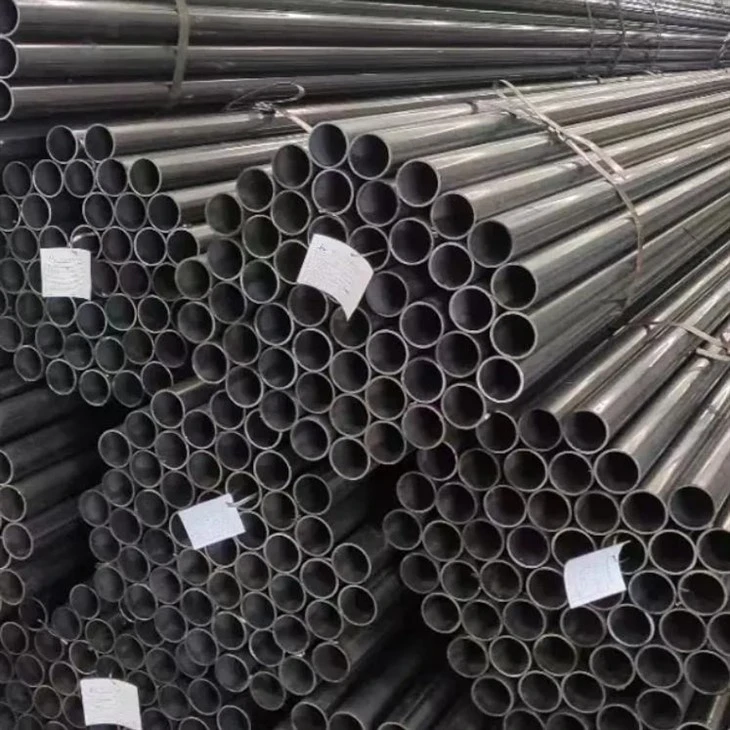
API 5L steel line pipe is engineered for long-distance transportation of petroleum, natural gas, water, and slurry. Covering Product Specification Levels PSL1 and PSL2, these pipes are manufactured in seamless (SMLS) and welded processes (ERW, LSAW, SSAW) to withstand high operating pressures, structural bending, and corrosive service conditions.
Key Product Characteristics
Tight yield-to-tensile ratios prevent premature plastic deformation under high internal hydrostatic pressure.
ow carbon equivalents (CE(IIW) <= 0.43, CE(Pcm) <= 0.25 for PSL2) ensure field weldability without pre-heating.
PSL2 grades undergo Charpy V-notch (CVN) impact testing down to -40°C to inhibit rapid ductile crack propagation.
Strict wall thickness tolerances (down to +/- 10%) and ovality control facilitate automated orbital welding on-site.
Technical Specifications
|
Parameter |
Seamless (SMLS) |
ERW (Electric Resistance) |
LSAW / SSAW (Submerged Arc) |
|
Outside Diameter (OD) |
1/2" - 24" (DN15 - DN600) |
2" - 24" (DN50 - DN600) |
16" - 60" (DN400 - DN1500) |
|
Wall Thickness (WT) |
SCH 20 to SCH 160, XXS (up to 40 mm) |
SCH 10 to SCH 80 (up to 16 mm) |
6.0 mm - 52.0 mm |
|
Length Range |
SRL (6m), DRL (12m), Custom up to 18m |
DRL (12m), Custom up to 18m |
DRL (12m), Custom up to 18m |
|
End Preparation |
Plain End (PE), Beveled End (30° / 37.5° per ASME B16.25) |
Plain End (PE), Beveled End |
Beveled End (Square cut optional) |
|
Production Standard |
API Spec 5L / ISO 3183 |
API Spec 5L / ISO 3183 |
API Spec 5L / ISO 3183 |
Grades & Standards
PSL1 vs. PSL2 Core Differences
- PSL1: Standard quality grade for general service. Mandatory chemical limits; non-destructive testing (NDT) is optional or limited. Impact testing is not required.
- PSL2: Higher technical specification for critical, high-pressure, or low-temperature pipeline projects. Requires compulsory CVN impact testing, full-body/weld NDT, strictly capped phosphorus (P <= 0.025%) and sulfur (S <= 0.015%), and trace carbon equivalent monitoring.
Material Grades & Delivery Conditions
Standard Grades: Grade B, X42, X46, X52, X56, X60, X65, X70, X80.
Delivery Suffixes:
- R: As-Rolled (e.g., X42R)
- N: Normalized / Normalizing Formed (e.g., X52N)
- Q: Quenched & Tempered (e.g., X65Q)
- M: Thermomechanical Rolled / TMCP (e.g., X70M)
Sour Service (Annex H): HIC (Hydrogen-Induced Cracking) and SSC (Sulfide Stress Cracking) tested per NACE MR0175 / ISO 15156.
Offshore Service (Annex J): Enhanced dimensional tolerances and ovality requirements for subsea installation.
Surface & Processing Options
Bare Pipe: Lightly oiled or un-oiled for temporary indoor storage.
External Coatings: 3LPE (3-Layer Polyethylene), 3LPP (3-Layer Polypropylene), FBE (Fusion Bonded Epoxy), Black Paint/Varnish.
Internal Linings: Liquid Epoxy for flow efficiency, Concrete Weight Coating (CWC) for submarine buoyancy control.
End Treatments: Square cut, beveling with plastic end protectors, compound beveling for thick-walled pipes.
Applications
Onshore Trunk Lines: High-pressure crude oil and natural gas transmission lines utilizing high-strength TMCP grades (X65M, X70M).
Gathering & Distribution Networks: Low-to-medium pressure utility pipelines using Grade B, X42, and X52 in ERW or seamless options.
Sour Gas Transmission: Wet gas and acid-containing hydrocarbon streams requiring Annex H HIC/SSC compliance.
Subsea Pipelines & Risers: Offshore deep-water applications demanding strict Annex J collapse resistance and tight wall tolerances.
Industrial & Mining Slurry: Mineral transport lines requiring internal wear resistance and elevated wall thickness.
Quality Control & Inspection
Every production run is subject to a structured Quality Assurance (QA) plan. Mill Test Certificates (MTC) are issued according to EN 10204 3.1 or 3.2.
Raw Material / Billets / Coil Inspection
Inspection and verification of chemical composition and surface quality of incoming raw steel billets, plates, or coils.
Heat Treatment
Controlled thermal processing according to specification requirements, including Normalizing, Thermomechanical Controlled Processing (TMCP), or Quenching & Tempering (Q&T).
Hydrostatic Testing
100% hydrostatic pressure testing performed on all pipes with a minimum pressure hold time of 5 seconds to ensure pressure boundary integrity.
Non-Destructive Testing (NDT)
- Ultrasonic Testing (UT): Full-body scanning and weld seam inspection for volumetric defects.
- Electromagnetic / Eddy Current Testing: Surface and near-surface defect detection for Seamless (SMLS) and Electric Resistance Welded (ERW) pipes.
- Radiographic Testing (X-Ray): Radiographic inspection targeted at weld seams and pipe ends.
Mechanical & Metallurgical Testing
- Tensile & Yield Testing: Transverse and longitudinal strength and elongation verification.
- Charpy V-Notch Impact Test: Low-temperature toughness testing performed from -20°C down to -40°C.
- Flattening & Bending Tests: Mechanical ductility and weld integrity evaluation.
- HIC & SSC Resistance Tests: Hydrogen-Induced Cracking and Sulfide Stress Cracking testing in accordance with NACE MR0175 / API 5L Annex H for sour service applications.
Dimensional, Wall Thickness & Bevel Inspection
Precision measurement of outside diameter (OD), wall thickness (WT), roundness/ovality, length, straightness, and end bevel angles.
Final Stenciling, Marking & Surface Protection
Application of required API stenciling, heat numbers, mill markings, surface coatings, and pipe end protectors prior to packaging.
Supply & Customization Options
- Custom wall thicknesses beyond ASME B36.10M schedules.
- Precision beveling angles to match specialized field welding procedures.
- Custom pipe length matching specific shipping container configurations (e.g., 5.8m for 20ft GP, 11.8m for 40ft HQ).
- Third-party inspection arrangements (SGS, BV, TUV, DNV, Lloyd's Register).
What Buyers Should Provide for a Quote
To receive an accurate commercial and technical quotation, include the following parameters in your inquiry:
Standard & Level: API 5L (PSL1 or PSL2).
Manufacturing Process: Seamless (SMLS), ERW, LSAW, or SSAW.
Grade & Delivery Condition: E.g., Grade B, X52N, X65Q, X70M.
Dimensions: Outside Diameter (OD) and Wall Thickness (WT) or Schedule (SCH).
Quantity: Total length (meters/feet) or total weight (metric tons).
Length Requirements: Single Random Length (SRL), Double Random Length (DRL), or Fixed Length (e.g., 12.0m).
Service Environment: Standard, Sour Service (Annex H), Offshore Service (Annex J), or Low-Temperature.
Coating Specifications: Internal/External coating type and thickness requirements.
Inspection: Special NDT coverage levels or required third-party agency (3.2 certification requirements).
FAQ
Q: Can API 5L Grade B pipe replace ASTM A106 Grade B pipe?
A: They overlap significantly in chemistry and strength, but they are not strictly interchangeable without MTC cross-verification. API 5L Grade B has tighter limits on residual elements and specifies different hydrostatic testing protocols. Dual-certified pipe (API 5L Gr. B / ASTM A106 Gr. B) is available upon request.
Q: What is the key advantage of PSL2 over PSL1 in high-pressure gas pipelines?
A: PSL2 mandates fracture toughness testing (Charpy V-notch), restricts chemical limits (P, S, C) to enhance field weldability, and enforces mandatory NDT on the pipe body and weld seams. This minimizes the risk of catastrophic line failure under fluctuating operating pressures.
Q: How do I determine whether to specify ERW, LSAW, or Seamless line pipe?
A: SMLS is used for small-to-medium diameters (up to 24") where seam welds are unacceptable or high wall thickness is required. ERW offers cost-efficiency and consistent wall thickness for 2" to 24" distribution lines. LSAW/SSAW is required for large-diameter mainline transmission above 20".
Q: What documentation accompanies each shipment?
A: Every shipment includes an EN 10204 3.1 Mill Test Certificate containing heat number, chemical composition, mechanical properties (yield, tensile, elongation), CVN impact results (PSL2), hydrostatic test pressures, NDT results, and dimensional verification reports.
Hot Tags: api 5l line pipe, China api 5l line pipe manufacturers, suppliers, factory