430 stainless steel (UNS S43000 / EN 1.4016) is a non-hardenable ferritic stainless steel containing 16.0%–18.0% chromium with minimal nickel content. It delivers strong atmospheric corrosion resistance, high resistance to stress corrosion cracking, and thermal oxidation stability up to 815°C (1500°F) in continuous service.
Because it contains negligible nickel, 430 stainless steel sheet offers a cost-effective alternative to austenitic grades like 304 while maintaining equivalent aesthetic quality and good formability. It is fully ferromagnetic in both annealed and cold-worked states.
Key Product Characteristics
Cost Stability: Nickel-free composition eliminates raw material surcharge volatility associated with LME nickel prices.
Stress Corrosion Cracking Resistance: Ferritic microstructure provides immunity to chloride-induced stress corrosion cracking that affects 300-series austenitic alloys.
Low Thermal Expansion: Coefficient of thermal expansion (10.4 x 10^-6/K) is lower than grade 304, reducing thermal deformation during heating cycles.
High Thermal Conductivity: Heat transfer rate (23.9 W/m·K) exceeds grade 304 by approximately 30%, making it suitable for heat exchangers and appliance heating panels.
Magnetic Response: Strong magnetic permeability allows usage in magnetic clamping systems, sensor platforms, and induction-compatible bases
Technical Specifications
Chemical Composition (Weight %)
|
Element |
Carbon (C) |
Chromium (Cr) |
Manganese (Mn) |
Silicon (Si) |
Phosphorus (P) |
Sulfur (S) |
Nickel (Ni) |
Iron (Fe) |
|
Standard Min/Max |
<= 0.12 |
16.00 - 18.00 |
<= 1.00 |
<= 1.00 |
<= 0.040 |
<= 0.030 |
<= 0.75 |
Balance |
Mechanical Properties (Annealed State)
|
Property |
Metric Value |
Imperial Value |
Standard Requirement |
|
Tensile Strength (Rm) |
450 - 600 MPa |
65 - 87 ksi |
ASTM A240 / EN 10088-2 |
|
Yield Strength (Rp0.2) |
>= 260 MPa |
>= 38 ksi |
ASTM A240 / EN 10088-2 |
|
Elongation (A50mm) |
>= 20% |
>= 22% |
ASTM A240 / EN 10088-2 |
|
Hardness (HRB) |
<= 88 HRB |
<= 88 HRB |
ASTM A240 |
Physical Properties
Density
7.75 g/cm³ (0.28 lb/in³)
Modulus of Elasticity
200 GPa
Electrical Resistivity
0.60 x 10^-6 Ω·m
Grades & Standards
430 stainless steel sheets meet or exceed international material standard specifications:
USA: ASTM A240 / ASME SA240, UNS S43000, AISI 430
European Union: EN 10088-2, Werkstoff Nr. 1.4016, X6Cr17
Japan: JIS G4305 SUS430
China: GB/T 3280 10Cr17 / 1Cr17
Surface & Processing Options
Surface Finishes
- 2B (Cold Rolled, Annealed, Pickled, Pinch Passed): Smooth, slightly reflective mill finish suitable for general deep drawing and stamping operations.
- BA (Bright Annealed): Highly reflective surface processed in an atmosphere-controlled furnace; used for home appliance trim and architectural panels.
- No. 4 (Brushed / Satin): Unidirectional linear grain produced with 150–240 grit abrasives; standard for kitchen equipment and decorative architectural elements.
- HL (Hairline): Continuous long-grain vertical polish for high-end elevator panels and interior cladding.
- 8K (Mirror): Highly polished specular finish without visible grit lines.
Protective Film: PE, PVC, or Laser-PVC films (70–100 μm) applied to single or both sides to prevent surface scratching during fiber laser cutting, stamping, and roll forming.
Deep Processing
- Precision coil slitting (+/- 0.1 mm width tolerance)
- Cut-to-length shearing (+/- 0.5 mm length tolerance)
- Fiber laser cutting, punch pressing, and custom edge conditioning.
Applications
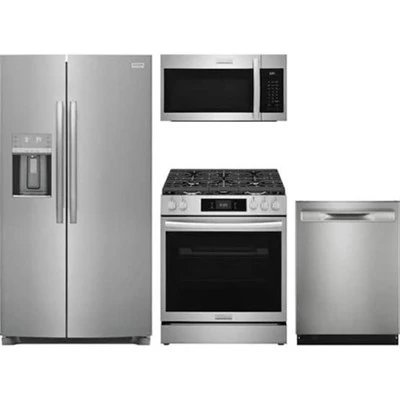
Washing machine drums, dishwasher door liners, microwave oven interiors, refrigerator doors, and range hoods.
Automotive exhaust clamps, trim components, muffler shells, and body molding clips.
Commercial food service counters, splashbacks, table tops, cutlery, and cookware induction bases.
Elevator door skins, column covers, wall cladding, and cabinet hardware.
Quality Control & Inspection
Every production lot undergoes rigorous inspection to guarantee full compliance with customer engineering requirements:
Chemical Verification: Optical Emission Spectrometry (OES) heat analysis to verify Cr, C, and P/S residual limits.
Mechanical Testing: Tensile, yield, elongation, and Rockwell hardness testing according to ASTM E8/E18.
Dimensional Inspection: Laser thickness gauge measurement across edge, quarter, and center points to verify tolerance compliance (EN 10051 / ASTM A480).
Surface Defect Detection: Automated optical inspection for pits, roller marks, scratches, or micro-cracks.
Certification: EN 10204 3.1 Mill Test Certificates (MTC) supplied with every shipment, detailing actual heat numbers, chemical composition, and mechanical test results. Third-party inspection (SGS, TUV, BV) available upon request.
Supply & Customization Options
Thickness Range: 0.3 mm to 3.0 mm (Cold Rolled); 3.0 mm to 8.0 mm (Hot Rolled)
Standard Widths: 1000 mm, 1219 mm (4 ft), 1250 mm, 1500 mm, or custom slit widths down to 20 mm
Length: 2000 mm, 2438 mm (8 ft), 3048 mm (10 ft), or customized sheet lengths
Packaging: Sea-worthy export packaging using wooden pallets, waterproof kraft paper, inner steel sleeves, and heavy-duty steel strapping.
What Buyers Should Provide for a Quote
To receive an accurate commercial quotation within 24 hours, please supply:
Dimensional Specifications: Thickness, width, and length (or coil weight required).
Surface Finish & Coating: Desired surface finish (2B, BA, No. 4, 8K) and protective film type (e.g., 80 μm Laser PVC).
Quantity: Order weight in metric tons (MT) or number of sheets.
Processing Requirements: Slitting, shearing, laser cutting, or specific edge tolerances.
Delivery Terms & Destination Port: Incoterms (FOB, CIF, CFR, DDP) and final discharge port.
FAQ
Q: What is the main difference between 430 and 304 stainless steel sheets?
A: Grade 430 is a ferritic alloy containing 16–18% Cr and almost no nickel, making it magnetic and cost-effective. Grade 304 is an austenitic alloy containing 18% Cr and 8% Ni, offering superior formability and corrosion resistance in marine or acidic environments. 430 is preferred for indoor dry applications, decorative trim, and cost-sensitive products.
Q: Can 430 stainless steel sheet be welded?
A: Yes, but with limitations. Grade 430 can be welded using TIG, MIG, and spot welding. High heat inputs cause grain coarsening in the Heat Affected Zone (HAZ), reducing impact toughness. Post-weld annealing at 790–815°C is recommended to restore ductility in structural joints. AWS ER308L filler wire is commonly used when joining to austenitic grades.
Q: Will 430 stainless steel sheet rust outdoors?
A: 430 provides good atmospheric corrosion resistance under normal conditions. However, long-term exposure to salt spray, coastal atmospheres, or heavy industrial pollution can cause surface staining. Regular cleaning or applying a polished surface finish (such as BA or No. 4) helps maintain corrosion resistance.
Hot Tags: 430 stainless steel sheet, China 430 stainless steel sheet manufacturers, suppliers, factory