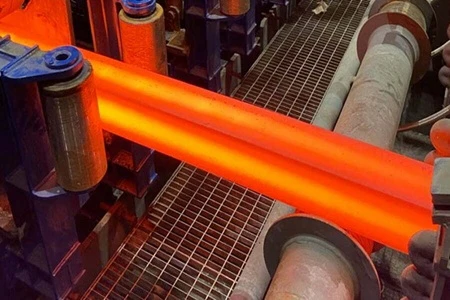
When a steel mill produces heavy H-beams, I-beams or other structural sections, the choice of starting material can have a direct impact on rolling efficiency, energy consumption and material yield. Beam Blank was developed around this practical problem: instead of starting with a conventional square or rectangular bloom and creating the beam profile almost entirely through rolling, the caster produces a cross-section that already resembles the basic geometry of the finished section. This near-net-shape approach makes Beam Blank particularly interesting for mills looking to optimize the connection between continuous casting and section rolling.
What Makes Beam Blank Different?
A conventional bloom is normally rectangular or square, while Beam Blank has a characteristic web-and-flange configuration. The shape is not intended to be the final structural beam; rather, it is an intermediate form that leaves less material for the roughing mill to redistribute. In practical terms, this means that the rolling mill spends more of its deformation capacity on refining the section instead of creating the entire beam geometry from a simple block.
The technology has been used commercially for decades. Public technical literature traces early industrial development to Algoma Steel in Canada, while later installations demonstrated the potential of near-net-shape casting for heavy structural sections. Research and industrial reports also show that Beam Blank casting requires careful control of mold geometry, steel flow and secondary cooling because the more complicated cross-section creates different solidification conditions from a conventional bloom.


Beam Blank vs Conventional Bloom
The most important comparison is not simply shape; it is what happens after casting. With a conventional bloom, the roughing mill must perform substantial deformation before the material reaches a suitable geometry for finishing. With Beam Blank, the initial cross-section is already closer to the target beam, so fewer breakdown passes may be required.
A documented industrial example illustrates the difference. Technical material describing Stahlwerk Thüringen reports that an IPE 300 section previously produced from an 80 × 300 mm rectangular bloom required 11 breakdown rolling passes, while the use of a beam-blank cross-section reduced this to five passes. Such figures are plant- and product-specific rather than universal benchmarks, but they demonstrate why Beam Blank remains relevant where rolling efficiency is a major commercial consideration.
Beam Blank vs Billet
Billet and Beam Blank should not be treated as interchangeable products. Billets are generally designed for products such as bars, rods and smaller sections, while a beam blank is specifically engineered around structural section production. For a mill producing large H-beams or I-beams, using a conventional billet or bloom may require considerably more shaping work before the final profile can be established.
That difference becomes especially important when production volume is high. A well-designed Beam Blank can help reduce unnecessary deformation during the early rolling stages, which may translate into lower roll wear, lower energy demand and better utilization of existing mill capacity. Primetals Technologies describes near-net-shape beam-blank casting as an alternative to conventional bloom casting, particularly when the caster is closely integrated with the section mill.
Why Near-Net-Shape Casting Matters
The commercial value of Beam Blank comes from the relationship between casting and rolling rather than from the cast product alone. A near-net-shape section can reduce the amount of reheating and roughing work required before finishing, especially when the production line is designed for direct or hot charging.
European technical documentation on ferrous-metal processing identifies several potential benefits of beam-blank casting, including reduced rolling costs, increased productivity, improved yield and lower energy consumption. The same source notes that applicability depends on plant layout, continuous-casting equipment and product specifications. In other words, Beam Blank should not be viewed as a universal replacement for blooms; its value depends on whether the complete steelmaking and rolling route is designed to use the geometry effectively.
Quality Control Is More Important Than Shape Alone
A common purchasing mistake is to evaluate Beam Blank only by its external dimensions. The geometry is important, but casting quality is equally critical because defects originating in the blank can influence downstream rolling performance and final beam quality.
The more complex cross-section of a Beam Blank creates specific metallurgical challenges. Research into beam-blank continuous casting has examined mold flow, solidification behavior, shell growth and the influence of nozzle design. Historical industrial work at Kawasaki Steel's Mizushima Works also documented the importance of mold powder selection, cooling conditions and equipment maintenance in maintaining cast quality.
For buyers, this means a serious Beam Blank specification should address more than steel grade and dimensions. Heat traceability, chemical composition, dimensional tolerances, surface condition and agreed inspection procedures should all be considered before commercial production begins.
What Steel Mills Should Consider Before Buying Beam Blank
The correct Beam Blank specification starts with the finished product rather than the blank itself. A buyer should normally provide the target H-beam or I-beam size, steel grade, rolling mill configuration and expected production volume. These details allow the supplier to assess whether the proposed blank geometry is appropriate for the intended reduction schedule.
For example, a blank suitable for one mill may not be optimal for another mill because the available breakdown stands, roll configuration and finishing equipment can be different. Technical literature on hot rolling also shows that the deformation behavior of near-net-shape sections depends on factors such as material strength, roll gap, existing surface defects and the rolling schedule. Therefore, Beam Blank sourcing should be approached as a technical matching exercise rather than a simple commodity purchase.
Where Beam Blank Creates the Most Value
The strongest application for Beam Blank is generally the production of medium to heavy structural sections where the near-net-shape geometry can meaningfully reduce breakdown work. H-beams, I-beams and wide structural profiles are typical examples.
For a rolling mill already producing these products at substantial volume, even a modest improvement in yield, energy use or mill utilization can become commercially meaningful over thousands of tonnes. This is why established beam-blank technology continues to attract attention despite the additional technical requirements associated with casting a complex cross-section. The objective is not simply to produce a different type of semi-finished steel; it is to improve the economics of the entire casting-to-rolling route.
Choosing a Beam Blank Supplier
When evaluating a Beam Blank supplier, price should be only one part of the decision. Buyers should also examine whether the supplier can consistently control chemical composition, casting dimensions, surface quality and heat traceability. More importantly, the supplier should understand how the blank will be processed after delivery.
A useful quotation request should therefore include the target beam size, steel grade, required quantity, delivery destination and, where available, a drawing of the existing blank or rolling schedule. A technically capable Beam Blank supplier can then determine whether the requested section is commercially and metallurgically suitable instead of simply offering a standard dimension.
Final Considerations
The continuing value of Beam Blank comes from a straightforward manufacturing principle: put more of the final structural-section geometry into the casting stage and reduce unnecessary deformation during rolling. Compared with conventional blooms or billets, this approach can provide meaningful advantages in the right production environment, including fewer roughing passes, reduced energy requirements and better mill productivity.
However, Beam Blank is not automatically the best option for every steel plant. Its benefits depend on caster capability, rolling-mill configuration, steel grade, final section size and production volume. For buyers considering a new supply source, the most effective starting point is therefore a technical discussion based on the actual beam specification rather than a generic product catalogue.
If you are sourcing Beam Blank for H-beam, I-beam or heavy structural-section production, provide the target section size, steel grade and required quantity. A supplier can use these details to evaluate the appropriate blank geometry, quality requirements and production route, giving you a more realistic basis for both technical comparison and commercial quotation.