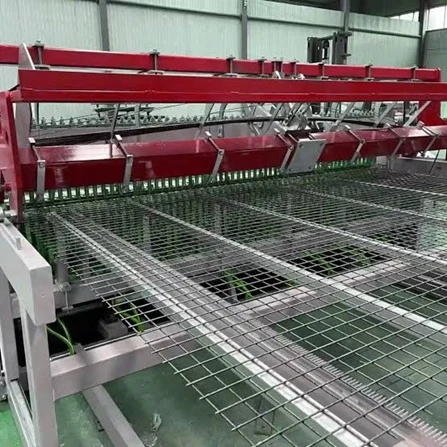
Galvanised Reinforcing Mesh: Choosing the Right Steel Mesh for Concrete Projects
When concrete is expected to perform for decades, reinforcement should not be treated as a minor detail. The right mesh can influence crack control, durability, installation speed, and the overall efficiency of a project. Galvanised Reinforcing Mesh has become a practical choice for projects where steel reinforcement may be exposed to moisture, humidity, or demanding environmental conditions.
Unlike ordinary black welded wire mesh, Galvanised Reinforcing Mesh combines a welded steel grid with a zinc coating designed to provide additional protection against corrosion. The result is a reinforcement solution that can be considered for concrete slabs, walls, precast components, agricultural structures, drainage works, and other construction applications where long-term material performance matters.
What Is Galvanised Reinforcing Mesh?
Galvanised Reinforcing Mesh is manufactured by welding steel wires into a regular grid before or after galvanising, depending on the production process. The choice of coating method affects the final surface condition, coating consistency, and suitability for a particular application.
For concrete reinforcement, specifications should never be selected simply by looking at wire diameter. Buyers normally need to consider wire size, aperture, sheet dimensions, steel grade, welding quality, galvanising method, zinc coating requirements, tolerances, packaging, and applicable standards.
For example, ASTM A1060 covers zinc-coated steel welded wire reinforcement for concrete and recognises both plain and deformed wire configurations. ISO 14657 also specifies requirements for zinc-coated steel reinforcement products, including wire and welded fabric.
This is why experienced exporters normally confirm the customer's structural drawings and local standard before recommending Galvanised Reinforcing Mesh rather than simply quoting the cheapest specification.


Galvanised Reinforcing Mesh vs Black Reinforcing Mesh
The most common comparison is between galvanised and uncoated welded mesh.
Black reinforcing mesh generally has a lower initial material cost and is widely used in standard indoor or well-controlled concrete applications. However, the exposed steel surface has no zinc barrier. If transportation, storage, construction, or service conditions create prolonged exposure to moisture, corrosion can become a concern.
Galvanised Reinforcing Mesh, on the other hand, introduces a zinc coating that provides additional corrosion protection. This can be particularly useful for applications involving damp environments, coastal construction, agricultural buildings, drainage infrastructure, or concrete products that may experience more aggressive exposure.
The important point is that galvanising does not automatically make every project better. If the concrete design, exposure class, reinforcement specification, or local code does not require corrosion protection, an uncoated product may be more economical.
A professional purchasing decision therefore compares the complete project cost rather than only the price per tonne of Galvanised Reinforcing Mesh.
Galvanised Reinforcing Mesh vs Rebar
Rebar and welded mesh serve different structural purposes, so they should not be treated as interchangeable products.
Reinforcing bars are particularly useful where concentrated reinforcement is required in beams, columns, footings, heavily loaded structural members, or complicated reinforcement arrangements. Welded mesh is often more convenient for slabs, walls, pavements, panels, and large areas where a regular reinforcement pattern is required.
One practical advantage of Galvanised Reinforcing Mesh is installation efficiency. A prefabricated grid can cover a large surface area with consistent spacing, reducing the amount of individual wire or bar positioning required on site.
In Australia and New Zealand, industry guidance commonly distinguishes between bars and welded mesh, with mesh frequently associated with floors and walls while bars are widely used in beams and columns.
For a slab project, for example, the decision may come down to whether the engineer needs a regular distributed reinforcement pattern or individually designed reinforcement bars. Galvanised Reinforcing Mesh becomes especially attractive when corrosion protection and rapid installation are both important.
Galvanised Reinforcing Mesh vs Fibre Reinforcement
Concrete fibres are another alternative that buyers may consider. Steel, glass, polypropylene, and other fibres can be incorporated into concrete for specific performance requirements.
However, fibre reinforcement and Galvanised Reinforcing Mesh are not always direct substitutes. Fibres are distributed throughout the concrete mix, while welded mesh creates a defined steel reinforcement grid.
For some industrial floors, precast products, shotcrete applications, or crack-control systems, fibres may provide operational advantages. For slabs or panels where a specified reinforcement grid is required, welded mesh can be easier to inspect and position.
A good supplier should therefore avoid saying that one product is universally superior. The correct solution depends on structural design, concrete thickness, load conditions, exposure environment, installation method, and local regulations.
Where Is Galvanised Reinforcing Mesh Used?
One of the strongest advantages of Galvanised Reinforcing Mesh is its flexibility across different construction environments.
Typical applications include:
Concrete floor slabs
Industrial floors
Precast concrete panels
Concrete walls
Pavements and hardstand areas
Agricultural buildings
Drainage and water-related structures
Retaining and landscaping structures
Coastal and humid construction environments
Concrete products requiring additional corrosion protection
For agricultural projects, for example, reinforcement may be exposed to humid air, fertiliser residues, animal waste, or repeated wetting and drying cycles. In such conditions, corrosion protection can become a more important purchasing consideration.
In one representative export scenario, a contractor purchasing reinforcement for an agricultural concrete flooring project could specify a 6 mm wire diameter with 150 × 150 mm openings, supplied in standard sheets. A shipment of approximately 20 tonnes would be practical for a medium-sized project. The exact specification, however, should be confirmed against the engineer's drawings rather than copied from another project.
A Practical Export Case: Why Specification Matters
Consider a representative overseas construction order involving a warehouse slab. The buyer initially requested ordinary welded mesh because the material price was lower.
During technical communication, the project team identified that the warehouse was located in a high-humidity coastal area and that the reinforcement would experience extended exposure during transportation and construction. The buyer therefore reviewed Galvanised Reinforcing Mesh as an alternative.
For the illustrative order, the selected specification was 6 mm wire, 150 × 150 mm aperture, standard sheet format, with the galvanising requirement confirmed before production. The quantity was approximately 18 tonnes.
The important lesson was not simply that galvanised mesh cost more. The buyer was comparing the material cost with handling conditions, expected service environment, and potential corrosion-related maintenance.
This is the type of project information that makes a product page more useful than a generic statement such as "galvanised mesh is strong and durable."
How to Select the Right Galvanised Reinforcing Mesh
Before placing an order for Galvanised Reinforcing Mesh, international buyers should confirm at least seven points:
Wire diameter
Mesh opening
Steel grade and mechanical requirements
Galvanising process and coating requirement
Sheet or roll dimensions
Applicable ASTM, ISO, EN, AS/NZS, or project-specific requirements
Packaging and container-loading requirements
The applicable standard can vary significantly between markets. For example, New Zealand's building guidance references Grade 500E reinforcing mesh for certain slab-on-ground applications, while the material requirements are linked to relevant reinforcement standards.
It is therefore risky for an exporter to recommend a generic Galvanised Reinforcing Mesh specification without first understanding the destination market.
For large projects, buyers should also request mill certificates, coating information, dimensional inspection records, welding quality documentation, and photographs of finished bundles before shipment where appropriate.
Why Experienced Suppliers Make a Difference
Buying Galvanised Reinforcing Mesh internationally is not simply a matter of finding the lowest quotation. A small difference in wire diameter, aperture, coating requirement, sheet size, or packing method can affect both material weight and project performance.
An experienced export supplier should be able to discuss drawings, calculate approximate weight, recommend suitable sheet dimensions, explain galvanising options, prepare loading plans, and identify potential specification conflicts before production.
This becomes particularly important when customers are purchasing several containers. A mistake that seems small on one bundle can become expensive when multiplied across 20 or 50 tonnes.
In our representative export experience, customers who provide drawings or detailed specifications at the quotation stage usually receive more accurate pricing and encounter fewer changes after order confirmation.
Final Thoughts
Galvanised Reinforcing Mesh is not simply "welded wire mesh with a zinc coating." For the right project, it can provide a practical combination of reinforcement, regular mesh geometry, installation efficiency, and additional corrosion protection.
The best choice depends on the actual application. Black mesh may be sufficient for some standard concrete work, rebar may be preferable for concentrated structural reinforcement, and fibre reinforcement may suit particular concrete mixes. But where a distributed steel grid is required and environmental exposure is a concern, Galvanised Reinforcing Mesh deserves serious consideration.
For international buyers, the most reliable approach is to start with the engineering requirement, identify the applicable standard, confirm the mesh specification, and then compare suppliers on material quality, galvanising, production consistency, inspection, packaging, and delivery-not just the quoted price.
That process turns Galvanised Reinforcing Mesh from a commodity purchase into a properly engineered reinforcement solution.